Ticket revenue and reinvestment in live music: international professional exchange takes shape at the Reeperbahn Festival
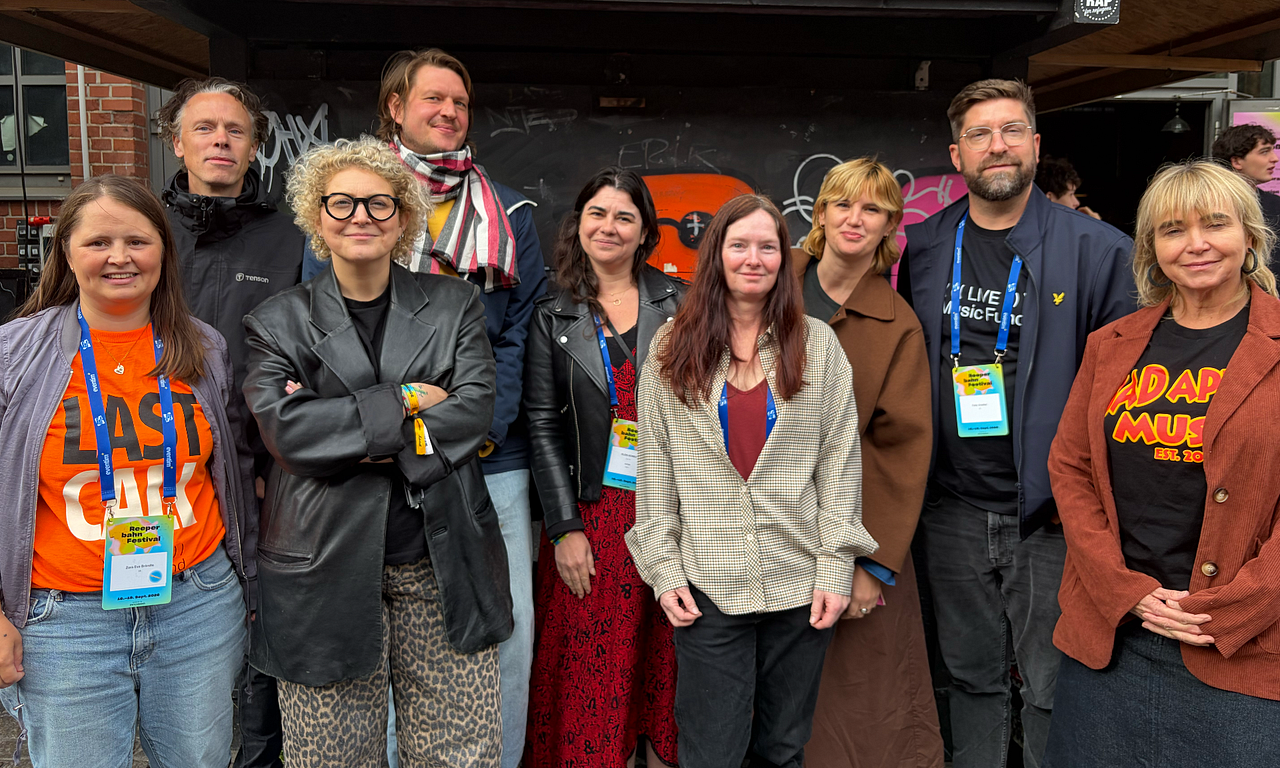
Alteglofsheim/Hamburg, 25 September 2026. At this year’s Reeperbahn Festival, Live DMA and the LiveKultur Federal Foundation have organised an international expert roundtable on ticket levies to support small and independent venues. The meeting builds on a broader exchange among Live DMA members held in May 2026, which was attended by organisations from across Europe – including Switzerland, Spain, Belgium, the Netherlands, Norway, Estonia, Hungary and Italy – to map national developments and identify common approaches. In Hamburg, delegates from Germany, Switzerland, Australia, Spain and Sweden took the discussion further; organisations from France, Canada and other global partners are expected to join the exchange as it grows.
Shared challenges, different models
A ticket levy deducts a small contribution from ticket sales and reinvests it in the live music ecosystem. The models vary from country to country: they may be voluntary or statutory in nature and may be implemented by arenas, promoters or the club sector itself. At the heart of these discussions lies a simple idea: this is not about charity, but about reinvesting in an interdependent ecosystem. The venues and promoters, who bear the earliest artistic and financial risks, create value for the entire live music value chain, including large promoters, arenas, festivals and ticketing companies.
In the UK, the voluntary £1 contribution is collected via participating arena and stadium shows and administered by the LIVE Trust; organisations such as the Music Venue Trust deliver support to the grassroots sector. In 2026, the Music Venue Trust launched its first venue support projects based on an initial allocation of 200,000 pounds from the Trust. Beyond its role in the United Kingdom, the Music Venue Trust has played a key role in shaping this international exchange: through networking and ongoing cross-border collaboration, it has enabled emerging initiatives to learn from one another rather than starting from scratch. In Germany, the nationwide ‘Club Euro’ pilot project, launched in September by the Federal Foundation LiveKultur and supported by LiveMusikKommission e.V. (LiveKomm), is based on the ‘1-Euro’ model already in operation in Cologne. Starting with clubs is a pragmatic first step, not the final answer: the long-term aim is to integrate major event organisers, arenas, festivals and ticketing companies into a broader reinvestment structure.
Further discussions can also build on developments in France, Canada and the USA, where various forms of reinvestment are already being implemented, are in the planning stage or are the subject of public debate. The common goal is mutual learning and a shared substantive concern: to protect and preserve small and independent venues, which serve as the birthplaces of so many international music careers – the places where the artists of tomorrow develop before they go on to fill the major arenas. The message is clear: reinvestment mechanisms are evolving from isolated experiments into a serious international debate on the future of independent venues. The participants also emphasised that reinvestment mechanisms must complement, not replace, public funding for the arts.
From exchange to permanent international cooperation
The Hamburg meeting was designed to transform parallel developments into coordinated progress. The participants agreed to press ahead with the establishment of a permanent peer group under the umbrella of Live DMA. The group is to meet approximately quarterly and focus on the practical aspects of implementation: the exchange of legal frameworks and operational models, the identification of best practices in different regulatory environments, and the support of venues and organisers as they move from principle to practice.
“The momentum is already there – now it’s about designing mechanisms that are fair, transparent and tailored to the respective context,” says Erica Romero Pender of LiveDMA.
“The artists who fill arenas today started out in clubs with a capacity of 200. These clubs must survive so that the next generation has the same opportunity. The ticket levy is the industry’s way of taking responsibility for its own ecosystem,” adds Felix Grädler of the LiveKultur Federal Foundation.
You might also like these articles


Join the community!
Subscribe to our eventletter for the latest news from the events industry.